Thursday, May 9, 2013

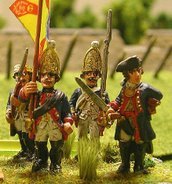
28mm Austrian Napoleonic Grenadiers (2)

This is the second unit of 28mm Austrian grenadiers that I've purchased from one of my new favorite figure sellers on ebay, ppsbay_com. This will complete my Grenadier regiment for my friend Charlie's homebrew rules, Napoleon's Rules of War.

I purchased these figures based singly. I've re-based them using my normal basing process that I've recently documented.

Below is a photo of both battalions which could make up a small regiment.


Monday, May 6, 2013

Carthaginian Chariots

When Mike thought of doing an earlier campaign in Italy and the Mediterranean he originally thought of doing the Italian wars prior to the first Punic War. During the discussion of this I purchased these figures to use with my existing army to start an early Carthaginian army. Later in the discussion we brought in additional players and a First Punic War campaign fit the lead we all had better. Still I had these figures and they were partially painted, so they'll be part of the campaign representing the last gasping breath of chariot warfare in Carthage.....i.e. I bought them and painted them so we're using them! They'll replace one of my elephant battle groups in my army.

These figures are from SHQ Miniatures. I think they'll match up favorably to the Old Glory figures in the rest of my army just fine. I'm counting these as 32 figures in my 28mm painting tally: 16 horses + 12 crewmen + 4 chariots. I'm definitely not of sound enough mental fortitude to paint an entire chariot army. This one battle group almost broke my will. Too much painting for a semi-effective combat unit in my opinion.


Sunday, May 5, 2013

Huzzah! 2013

This weekend was the Huzzah! 2013 Wargaming Convention. I was only able to attend Friday night and Saturday morning and afternoon sessions due to other commitments. Still I had a great time. This was the first year for the convention in a new hotel conference center and I have to say the new venue is a great improvement. There was a lot more room, on site 'quick food' catering and separate rooms for board games, large on-floor games and also a Field of Glory ancients tournament. Although the convention spanned many areas, the majority of the action centered around the main ballroom where most of the games, the vendors and both WWII tournaments (Flames of War and Bolt Action) were held. Below is a video panorama of the ballroom on Friday evening. Please excuse the poor quality, my still camera suffers in video quality particularly in low light.


My good friend Gordon from Adler Hobby was there as both a vendor and also as the organizer of both of the aforementioned WWII tournaments. For my part I donated some prize support in the form of the sportsman prizes and donated my laser time to manufacture the trophies. Gordon did a nice job finding a variety of interesting 54mm figures which he painted to look like sculptures to decorate the award plaques.


Friday evening I pre-registered for a "paint and take" session hosted by Eric Jones of Hotspur Historicals. Eric is a fantastic painter and had a great session planned where we all followed his instructions to learn how to paint using his 'big battalions' method. This wasn't like any other speed painting techniques I've seen before. I learned a bunch of great tips: spot washing, how to efficiently black line small detail items like musket barrel straps and buttons, and other great tips like which colors to use with a wash so you get the correct final colors you desire. Even though I was painting in a dark room and not at my usual work station, Eric's techniques produced a great looking figure in a little more than two hours including instruction. I could probably reproduce these techniques on a half dozen figures in two hours at home. Twenty minutes per figure for something looking this nice is pretty awesome - especially for ACW Zouaves with lace details!

I've been painting figures for almost 30 years and I always benefit from learning how other people paint. Even if you're an experienced painter I highly recommend you participate in such seminars yourself. Also holding such a seminar at your club or with friends is a GREAT way for everyone to improve. A huge thanks to Eric for sharing his knowledge and for hosting such a great session.


Saturday during the mid-day session I played in a Carnage & Glory game hosted by Peter Lowitt. The game was the battle of Crysler's Farm 1813 - part of the war of 1812. This scenario showed how unique Carnage & Glory is. The battle featured a 4:1 advantage in numbers for the American army but the battle ended in a British victory. Fatigue from crossing battlefield obstacles and traversing muddy fields took a toll on the Americans in the battle and C&G models that well enough that as a scenario designer, Peter was allowed to use a historical order of battle and still host a competetive game. In the end this time the Americans lost horribly, but Peter has run this scenario several other times where the Americans have been able to achieve victory.  Thanks for the fun game Peter!

Also at Peter's table, but not part of the game, was a 28mm Monitor he built for anther game hosted at the convention by a friend of his. I was impressed at the workmanship of this scratch built gaming model.


Thursday, May 2, 2013

2nd Punic War Campaign Moves Spawn the Battle of Locsium

Monday evening Charlie, Mike and I got together to do the board game moves to generate the next battle for our ongoing Second Punic War campaign. Although Scipio Africanus arrived onto the scene recently he spent most of his time doing some much needed housekeeping in mainland Italy. By the time he got to Africa, Hannibal jumped Marcellus' army in Locsium, Western Numidia.  Marcellus is fresh off of a victory against Hannibal in Thevestis. One more victory and we might be calling him Marcellus Africanus.

In addition to each of their full 800-point Field of Glory armies each commander drew from locally controlled provinces additional forces. Hannibal drew on Carthaginian locals to raise a unit of Elephants and a unit of heavy cavalry. Marcellus raised three units of Numidian skirmishers and a unit of Numidian cavalry from the provinces of Eastern and Western Numidia. This should be another large game. We hope to settle it early in June after the Huzzah! convention, May club game night and a couple other games previously scheduled. When it comes to gaming we're currently experiencing an embarrassment of riches.


Monday, April 29, 2013

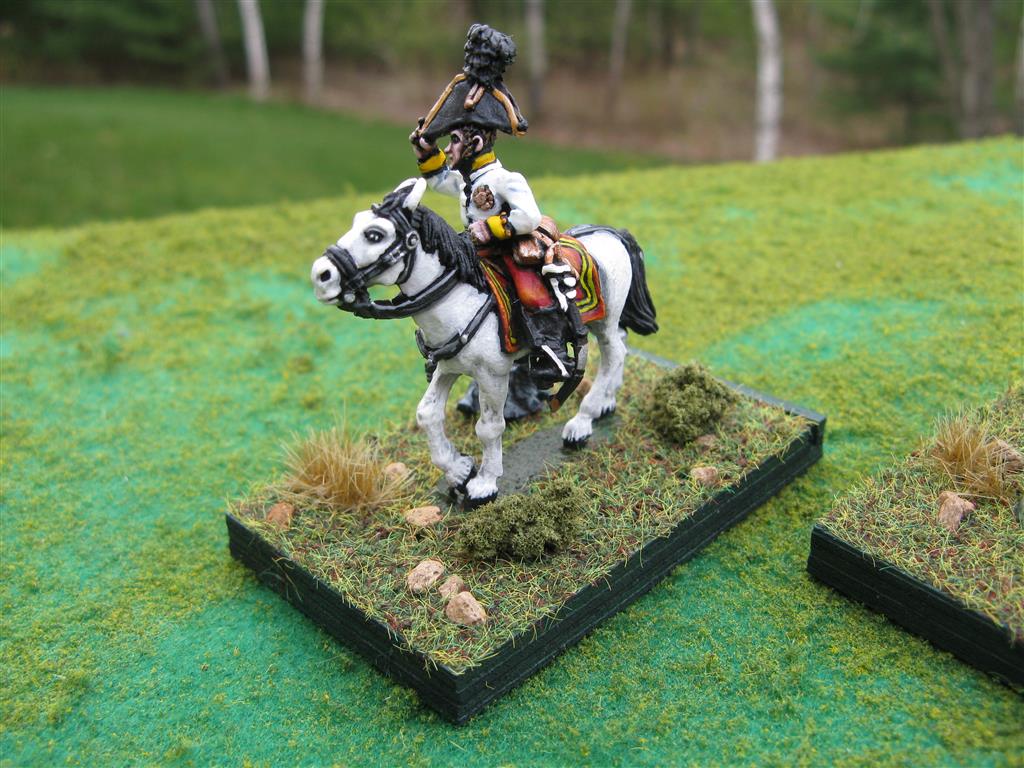
28mm Austrian Napoleonic Officers

This is another purchase from eBay for my 28mm Napoleonic Austrian force for my friend Charlie's new homebrew rules. These were purchased from a vendor that is new to me,  26wargamelady2011. The figures are very well painted and the packaging was good as well. You need to be careful when paying for figures from this vendor that multiple figure orders combine shipping properly. Mine did not but when contacted, the vendor was very responsive. I asked for extra figures instead of a refund and got what I asked for. Hard to complain with that type of service.

These are the figures that I used for my basing tutorial post last week in case anyone wants to see the final product from that post.

Sunday, April 28, 2013

The Battle of Gloucester Point, October 17th, 1781

Friday we got together in my basement to play test a scenario I'm working on that I plan to host at our club's May game night. Several of my friends and a few new players volunteered to help me play test it.

During the siege of Yorktown, across the narrows of the Chasapeake bay, a small force lead by Lieutenant Colonel Banastre Tarleton was penned in by a larger force comprised of Americans and French including the Lauzun's Legion Hussars commanded by Brigadier Marquis de Choisy. During this short time one of the few cavalry on cavalry conflicts of the war occurred when over 300 French Hussars of Lauzun's Legion clashed with a similar number of horsement from the Light Dragoons of Tarleton's legion. This action resulted in the unhorsing and wounding of Tarleton but only a few other casualties. Beyond this cavalry action the British were kept mostly in check behind their own defenses until the surrender of Yorktown. The day before the surrender, on the evening of October 16th, Cornwallis attempted an evacuation of Yorktown to Gloucester point by small boats. This evacuation ended up in failure when the boats were scattered during an overnight storm after only shuttling a few British soldiers across from the Light and Grenadier brigades.

This scenario assumes that the British were able to cross enough troops before the storm to amass a force large enough to attempt a breakout. A successful defeat of the encircling Franco-American force will allow Cornwallis to complete the evacuation of Yorktown and extend the war in America. An American victory confirms history and marks the end of major battles of the Revolutionary War.

On the left American commanders George (Danby's Legion) and Mike (Virginia Militia). On the right French commanders Mark (Lauzun's cavalry and marines) and Charlie (Lauzun's Infantry).

Here is the British contingent left to right Ed (Light Brigade), Byron (Hessian Brigade), Ralph (coaching new players), new Player Owen (grenadiers) and Rob (militia and loyalist forlorn hope).


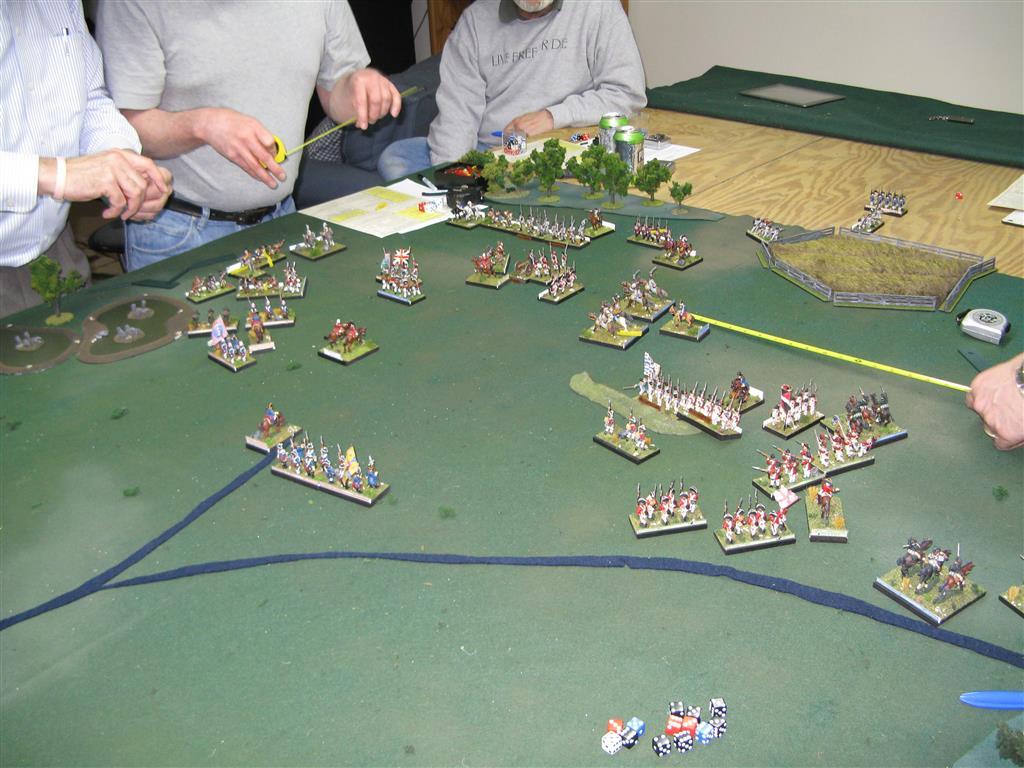


The scenario requires that the British, with their superior quality and numbers, eliminate the blocking American force. The British plan was solid, advance with their Loyalists and Queens rangers command to screen their grenadiers from the French battery and American muskets. Once in range the Grenadiers would go in for the kill. Germans in the center would follow up the Grenadiers and the Lights and Tarleton's cavalry would occupy the French keeping them out of the fight. In the end the Grenadier charge went particularly well and the lights were able to skirmish with the French effectively enough to neutralize them before the slower marching Germans made it into action.

I have a few tweaks to make to the scenario to make the Franco-American forces a bit more durable and threatening. I don't want to change too much too quickly though because the Grenadier attack and British plan was well executed, so I don't want to make it a lot tougher to succeed in case an average plan or execution happens at game night. In that case I want the game to be an even affair.


Thursday, April 25, 2013

My Figure Basing Method

On a recent post one of my readers asked me to do a step-by-step tutorial of my basing method. While I don't think my bases are as nice as some of the best seen on wargaming blogs, they're passable and my technique is super easy and super fast. I know a lot of wargamers dread basing, but with my method I find it quite easy and enjoyable. By request here is my method.

Step 1 - Prepare the base and Figure


I prefer 1/4" thick bases for my 28mm figures. The thicker bases give the player something other than my figures to grab onto. On my AWI armies I paint the whole base black with spray paint then hand paint the top Russian Green using cheap craft paints. For Napoleonics and Ancients I smartened up and paint the top and edges of the base with green spray paint from a can. I buy the cheap stuff at the department store for this use. The slots in the back of my bases are for labels and/or roster tags.

When I'm painting my figures I make sure the base of each figure is neatly painted with Russian green paint. An exact match to the bases isn't required, but the closer the better. Dry-brush the base if you like.


Step 2 - Prepare Talus / Stones

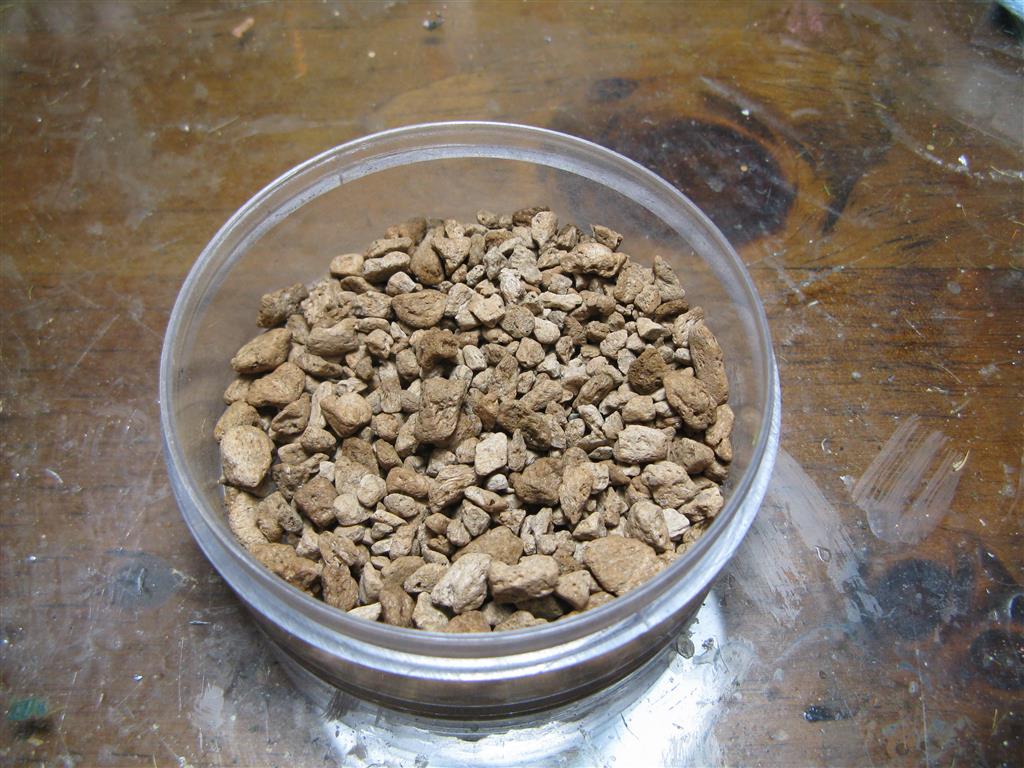
The stones I use are Woodland Scenics 'Talus'. A bag lasts forever. As you can see below  the stuff comes in an un-natural ivory white color. I water down some stain and in a paper cup stain a bunch of this stuff to a more earthy color. It's ok for the stones to not be uniform in color. I stir them up a bit in the stain and dump them out on a paper towel and dry them off. It sounds like a lot of work but I do it about once a year or less. I make enough to fill a Gale Force 9 terrain container up. One container will last several armies worth of basing.


Step 3 - Apply White Glue, Figures and Talus

I use white PVA 'School' glue - Elmers brand here in the USA. I put on a bunch and spread it evenly with a pallet knife. I then put my figure(s) on the stand exactly how I want them. If I'm basing cavalry I may use a toothpick to push some glue up onto the base between the horse's feet. I use white glue because it's inexpensive and makes removing the figures later for re-basing easy with an overnight soak in tap water

While the glue is wet I grab a pinch of talus stones and scatter them semi-randomly. At this time sometimes I also add bits of sand or other non-grass ground clutter. Woodland Scenics ballast and Gale Force 9 ground scatter products are both items I use. Whatever you choose have enough to use some on all of your bases.


Step 4 - Apply Static Grass

There are many brands and blends of static grass. I've used many and almost as a rule I've found them to be too 'neon' green and too fake looking. Also a pure static grass product doesn't have any other items and looks too much like a putting green for my tastes. I prefer Scenic Express "Farm Pasture Blend" ground cover. It's about 75% static grass with the remainder consisting of small foam turf clumps and small woody stick-like bits. Just enough to make your bases look like a field and not a putting green. Invest the $10 on a static grass applicator. I prefer the plastic squeeze bottle type so I can squirt the grass in between figures as I desire. Puff the grass on from above and let dry overnight. I do this into an old shirt box. You will apply 10 times as much product at the base requires. The next day shake the stands off into the box and re-use everything that didn't stick to the base.


Step 5 - Apply 'Detritus' to the blank areas of the base

I like to fill the empty spaces on my stands with what my friend George calls 'detritus' - non-figure scenic bits. For the most part I use Silfor Buffalo Grass clumps, Woodland Scenics foliage clusters in two colors and rocks made from broken up pieces of coarse cork board painted black and dry brushed grey. The latter I prefer to real rocks. Real rocks look too fake believe it or not.

For special stands I've been known to add broken cart wheels, barrels, tomb stones, weapons and even dead horses. The more variety the better when it comes to detritus! 90% of the painted items that are not figures are wooden items such as barrels and cart wheels. You would be amazed at how many of these you can paint up in one session of dry brushing and save for later. I keep such items in a drawer in my organizer. Another good source is the flea market at a show or club swap meet. That old ACW cannon looks too shoddy to use, break off the wheels and barrel and you have 3 pieces of detritus already painted up!


Wednesday, April 24, 2013

28mm 'German' Austrian Napoleonic Fusiliers

 Two units of Napoleonic German Austrian Fusiliers again purchased from ppsbay_com and re-based for Napoleon's Rules of War. Both of these came painted with the grey regimental facings, collars and cuffs shown on the right-hand unit. Fortunately for me the regimental color is also the color the painter uses for shading and lining making the task of changing the regimental color of the left-hand unit to green an easy task. I will most likely be doing this for other units in the future.