Friday, April 22, 2011

Flammenwerferpionieres

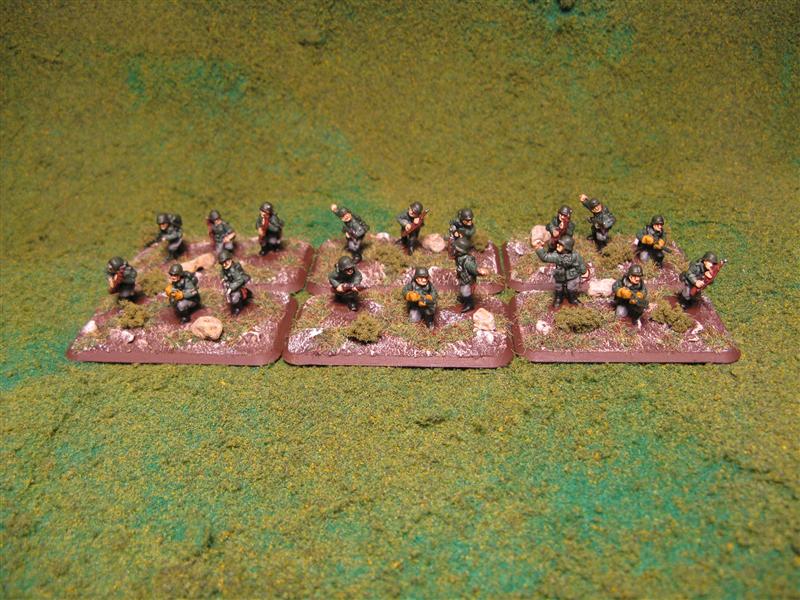
These are six stands of flamethrower-equipped German early-war pioneers. The early war German infantry pioneers can substitute up to one third of their rifle-armed pioneers with these nasty guys. They can be devastating to just about anything at short range including enemy armor and defensive emplacements and bunkers. These are always nice to have around. Six stands will give me the ability to have up to the maximum amount in my two infantry platoons: three stands per platoon.

These are Battlefront figures consisting of a mix of figures from the Finnish engineer, German mid-war engineer and German mid-war infantry blisters. Populating each stand with only three figures allows me to easily distinguish these from regular rifle-armed pioneer stands which have four figures per stand. Each of these stands contains a flame thrower-armed soldier (of course), an NCO of some sort and a rifle-armed private. With the extra space on the stand I was able to add some additional scenery and detritus to fill up the space. Next up on the painting table is some mid-war WWII British armor in desert camouflage for our North Africa campaign.
 

Sunday, April 17, 2011

North Africa & Northern Conspiracy Symposium

It's been a busy, but fun, week for me as far as wargaming goes. On Thursday evening I participated in some play testing of a set of WWII North Africa rules that Gordon from Adler Hobby created. We'll be starting up this campaign in a few weeks after the completion of our early war Escalation league while we wait for the next early war army list book to come out. The campaign is based on a combination of a few different campaign systems Gordon likes including elements from Battlefront's Firestorm series of games. We will be using the Battlefront North Africa army list book.

The idea behind moving to mid war is to enable the newer players from the early war escalation league to re-use many of their miniatures and get ready for the upcoming early war book, which will have some early war North Africa army lists in it. The campaign will be played with teams of two. Each player will field an 850-point force. Games will be approximately 2000-points with two 850-point player forces and a bonus platoon drawn from a common pool. This is another way to limit the amount of new lead newer players will have to paint.

In the top photos below you can see the Axis players: Italian armor and Italian infantry. The lower photos show the Allied players: British armor and American armor. Please excuse the un-painted models. Since this was a play test we used what we had. My models will be painted soon. In the play test we tried out the campaign map moves and played a game for some fun at the end. The game was a very one-sided affair. A German 88 all but wiped out the American Shermans and two Italian portee 90mm AT guns wiped out the entire British force. Seems the Allies need to find an answer to this.


* * * * * * * * * * * * * * * * * * * * *

Friday evening our club held it's first of what may become many lecture symposiums. Club president Mike Coppinger introduced this new idea and I think it's going to be a good addition to the club's activities. The lectures this time were given by club members Ralph Gero and Byron Champlin with guest speaker, and club alumni, Frank Chadwick.
Ralph's lecture subject was 'How to Run a Campaign'. This lecture spanned a lot of topics, ranging from types of campaigns to topics on map design, communication with players, and how to handle GM conflict.

By far the most entertaining portions of the talk for me were discussions about past campaigns we've had and situations that arose in them and how those situations related to the topics listed above. This was definitely an 'audience participation' lecture. Very entertaining as well as informative.
Byron's lecture was one he has given at the 18th century history conference. The topic was the first year of the Seven Years War. The lecture contained slides of maps and portraits of historical figures mentioned in the lecture. It covered everything from the political events leading up to the outbreak of the war and covered the military actions in all of the major military theaters of the war.

I've always had only an overview knowledge of the war - nothing more than can be gleaned from reading a few Osprey books. Byron's lecture was very informative and entertaining. In fact it has piqued my interest enough that those 15mm Seven Years War figures I have in my dead lead pile may have just shifted up a few notches on the 'to-do' list.

Our last lecturer was Frank Chadwick of Volley & Bayonet and Command Decision fame. Frank is also a Northern Conspiracy alumni member from when he lived here in New England. Frank was generous enough to travel up to deliver a very interesting talk on the Arab - Israeli 'October War' of 1972. I've attended several of Frank's lectures at Historicon and other events and they are always very entertaining and informative. This one was no exception. Although I usually consider my wargaming interests as ending on VJ day, this lecture has convinced me that there are other very interesting military actions after WWII. The forces involved in this conflict and the circumstances of the battles make for very interesting wargaming potential. Maybe some some micro armor is in my future......

Thanks to all of the lecturers. I had a GREAT evening attending the lectures.
Sunday, April 10, 2011

Early War Escalation League (6)

Yesterday we had another gathering of our Flames of War early war escalation league at Adler Hobby.  We're nearing the end of the escalation phase of the league and this week we were scheduled to begin our 1750 point games. Three players showed up: two French players, who played each other last time the league gathered while I was on vacation, and myself with German Pioneers or Czech Panzers. Since each of the French players played each other in a blue on blue game last week they were both looking for a new opponent....ME! Store owner Gordon hasn't finished enough of his Polish Cavalry to field a 1750 point army yet (although his armored train looks AWESOME) so we came up with a creative solution: Each French player would field a 1000-point company and Gordon and I would each field 1000 points of Germans from my collection and we would play a 2000-point 2 vs. 2 game for fun.

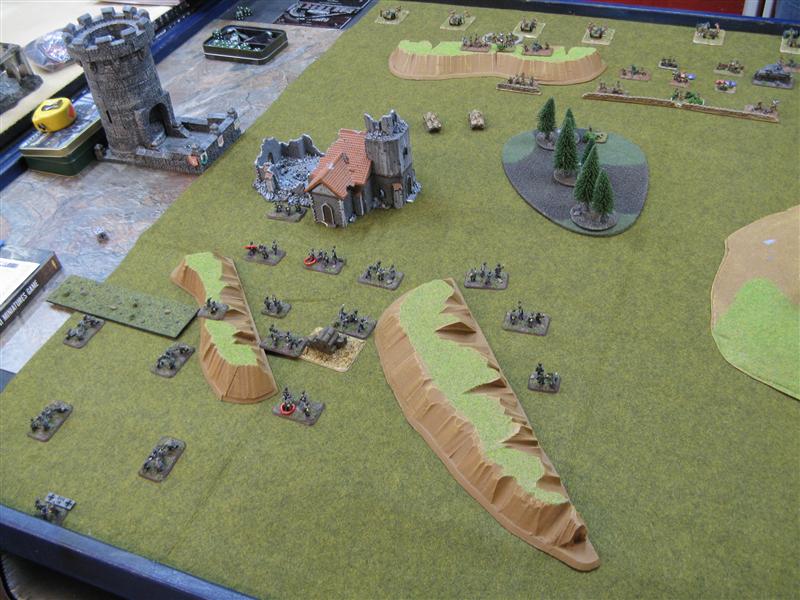
These photos and the one above are after the German half of the first turn and give a good indication of the initial deployments. Our German force on the left side of the battlefield consisted of a pioneer company containing a pioneer platoon with flame throwers, a battery of 105mm howitzers, a platoon of 105mm chemical mortars and a platoon of PaK 36 AT guns with some Stuka Air support. Opposite them was a French infantry company with two platoons of infantry, two batteries of artillery an AA gun battery and an AT gun battery.

 On the right flanks a French squadron of medium tanks with fighter anti-air cover opposite our German Czech Panzer Company. Our plan was simple: occupy the church ruin with the engineers hoping that their flame throwers would discourage any attack attempts on that flank and attack with full force on our right with our panzer company supported by the artillery and Stukas.

Early on things looked bleak as a platoon of French Hotchkis tanks gored our PaK36 platoon while they were still being towed by their trucks. This was due to a failed stormtrooper move to unlimber the AT guns.

Our main concern was the French Souua S35 Medium tanks. Their heavy armor was going to be a challenge for us to take out. Early in the game our only Stuka attack to get through the French fighter cover was lucky enough to take out a couple of the hard-skinned tanks along with a Hotchkis and an infantry stand. The remaining two S35 tanks were taken out by direct fire from our 105mm howitzers and some flank shots from our Panzer IIs. The Hotchkis squadron was dispatched by a combined effort from our 35(t) Czech tanks.  With the company commander of the French Armor eliminated earlier, they quit the field once their losses forced a company morale check.

We had VERY good luck early with the Stuka attack on the S35 platoon and this really helped us secure a victory. Without that one attack this would have been a bloody fight to the end. Still we all had a good time and I got to see my newly painted Panzer IIc and Czech 35(t) tanks get used which was good fun.  The photos above were taken close to the end of the game. Note the wrecked transports for the PaK 36 platoon and the wrecked French tanks.

Thanks to everyone for a fun game! See you all again soon.
AJ

Wednesday, April 6, 2011

Heavy Panzerpäh Platoon

This is a Heavy panzerpäh platoon of six Sd Kfz 231 (8-rad) armored cars. The three two-car patrols each can operate independently as individual platoons after deployment. This will provide great flexibility similar to that offered by my previously posted mixed panzerpäh platoon. I haven't decided if I'll use these alone with my Czech panzer company, or if I'll use them in conjunction with the mixed panzerpäh platoon in a kradschutzekompanie (motorcycle rifle company). The latter would be an all-recon company which might be really fun to play.

Kudos will go to the first person (other than my friend Gordon) who can identify the manufacturer of these models. These are the first models I've painted from this company. Lucky for me these match up in size exactly with Battlefront models. They're so close I could even mix them within a platoon if I wanted to. That shouldn't be necessary since six is the maximum I can take in any of the army lists in the Blitzkrieg early war book.

Sorry for the long time between posts. Since my last post I went on a week's vacation. Also since I really hate painting 15mm tires these took me extra long since each model has EIGHT of the darned things!

Saturday, March 19, 2011

Second Afghan War era (1878)

Last night we had our monthly game night. There were three excellent games hosted. I played in my friend Ed's second Afghan war era skirmish game. Ed's game uses a set of rules he's fashioned by combining his favorite parts of several rule sets into one set of rules. The majority of the mechanics come from Gaslight with other items thrown in from other rules.

This scenario pitted my friend Robert and I as the Afghans up against our friends Charlie and Ross playing the Imperial (British) forces. This was an interesting scenario where the Afghans had to close across open killing fields against the British defending a hill. In the end the game came down the the bitter end with our Afghan forces barely eeking out a win due to some fortunate ranged fire that allowed us to drive off the British artillery during the mid game. Fun and well run game. Thanks Ed!

Elsewhere at the event was our club President's annual DBA tournament and a huge 25mm Napoleonic game using the venerable 'Column, Line and Square' rules. Teaser photos of both are below, but there are a lot more photos in our club's photo gallery.

Wednesday, March 16, 2011

Recon!

This is a "Mixed Panzerspah Platoon" consisting of two patrols. Each patrol has one Sd Kfz 221 (MG) armored car and one Sd Kfz 222 (2cm) armored car it. This platoon can be used with almost any of the early war German TO&E lists in the Blitzkrieg book. Most interesting to me may be the Kradschutzenkompanie (Motorcycle Rifle Company) which can take three armored car platoons: a light platoon consisting of 3 or 6 Sd Kfz 221 (MG) armored cars, a mixed platoon consisting of 1-4 patrols such as these and a heavy platoon consisting of 2,4 or 6 Sd Kfz 231 (6-rad) or (8-rad) armored cars. Pair this up with two platoons of motorcycle infantry and you have an all recon force that should be quite interesting to command on the table top.

The Sd Kfz 222 (2cm) is my favorite early war armored car. Armed with both a 2cm main gun, a turret-mounted coax heavy MG and a self-defense AA MG, these are some very mobile gun platforms. These aren't going to go toe to to with enemy tanks, but they do have enough sting in them to give some light armor trouble in the right situations.
The Sd Kfz 221 (MG) armored cars share a similar chassis with the 222, but mount only the turret-mounted machine gun. The blisters for the 221s also contained the externally-mounted 2cm gun. I painted these up as well as the machine gun turrets instead of just tossing them into my spare parts bin. I think they actually look really fun. Hopefully the upcoming early war Africa campaign book will have this as an option so I can utilize these turrets.

Next up on the painting table is a return to working on my flame thrower infantry stands. 

Saturday, March 12, 2011

Train Raid

Today at Adler Hobby we play tested Gordon's train raid Flames of War scenario that he'll be putting on at the upcoming Huzzah! convention. This is an interesting scenario where a small raiding force of reconnaissance units attack some strategic points near the railway and then try to escape off the table. The attackers in this scenario are 8 small platoons of German armored cars. The defenders are a Polish armored train with it's accompanying assault infantry and light tanks and two platoons each of Polish cavalry and Polish tankettes.  The trick is to destroy the objectives and escape before the larger defending force destroys you....smash and grab at its finest.

Fellow escalation league participant Matt and I played the role of the convention goers manning the German armored cars. Gordon played the defending Poles. Initially Matt and I were successful in destroying two objectives each as well as putting some early hits on one platoon of Polish cavalry. Subsequent turns proved deadly for me with the loss of one of my platoons from fire from an ambushing platoon of Polish tankettes and losses elsewhere from the armored train's heavy guns. Matt took some losses, but was able to double time most of his attacking platoons to a safe distance and eventually off the board scoring two of the possible five victory points. I continued assaulting the remaining victory point with my light recon platoon while limping towards the exit with my other platoon. Eventually this limping platoon was stopped by a freshly arrived Polish cavalry platoon that succeeded in bailing out the sole surviving armored car with rifle fire! End result was a major loss by the Germans due to a couple of very effective ambushes by arriving Polish reserves. Interesting scenario and lots of fun. The Huzzah attendees should look for this game, particularly those looking to get a taste of Flames of War early war. 


Monday, March 7, 2011

Panzerkamphwagen 35(t) Tanks

These are seven Panzerkampfwagen 35(t) tanks. This is enough to transform my German Leichte Pionierkompanie force into a Czech Panzerkompanie by using two of these Panzer 35(t) tanks as the company headquarters and the remaining five as one of the two main combat platoons of tanks. The other combat platoon will consist of the Panzer IIc platoon that I've recently completed.  Weapons platoons will be one Leichte Pioneer platoon and a Kradschützen (motorcycle recon) platoon that I have purchased but not painted yet. Support platoons will be selected from those that I already have which include Stuka air support, a Panzerjager I platoon, a Panzer IVd platoon, some 8.8 cm "88" AA/AT guns, a PaK36 AT gun battery, and a battery of 10.5 cm leFH18 howitzers. More than enough options for me to pick something nice from.

Adding the Panzer 35(t) tanks to my force allows me the option to field my early war Germans as a tank company in addition to the mechanized infantry (pioneer) and foot infantry (pioneer) lists I previously completed. I think that's a pretty good economy of scale for only adding seven new tank hulls. Hopefully I'll get to try these babies out this weekend at our escalation league game day. I'm anxious to see how they'll hold up to French armor and nervous how they'll hold up to British Matildas. For the latter I'm counting on my Stukas, AT and artillery that's for sure!

I looked through my references and scoured the Internet for period photographs of the Panzzer 35(t). From what I found the most common location for national markings seems to be located on the front portion of the hull as shown in the above photo. Although there are many photographs of painted 15mm models with large insignia on the turrets, the only photos of actual tanks (not models) I could find with insignia on the turrets are large all white crosses, which were abandoned quickly because they made for good target locations for enemy AT guns. The other common turret markings were small white tank numbers. In the end I've settled on the above photo as my inspiration for marking location. I've skipped the small tank number plate as it's just too small for me to paint on a 15mm tank model.

 While doing my research I did find that since these were captured Czechoslovakian tanks many of the crews displayed aerial recognition flags on the rear portion of the hull of the tank. With most of the tank looking so plain I decided to try my hand at modeling this on the commander's tanks. This was done by printing out tiny flags on my printer, soaking them in PVA glue and attaching them to the tanks. I'm pleased with the result, although if I do this again I think I'll spray both sides of the flags with matte lacquer and let them dry so the white glue doesn't cause the flags to become transparent in places if too much glue is used. These photos were taken about an hour after applying the flags so there's still hope they will dry out some more. 

Friday, March 4, 2011

Viking Dawn Project

 Last night I got together with some of the Thursday night regulars at Adler Hobby to help assemble the store's figures to participate in the Viking Dawn event at the upcoming Huzzah! convention. The Huzzah! staff are opening up participation to 'Clubs' and since Adler hobby is a vendor and supporter of Huzzah! running the Flames of War events there, Gordon thought it would be good for the store regulars to participate as a club in the Viking Dawn event.

With the convention coming up soon, we got together tonight to assemble over 70 viking figures provided by the convention organizers, and their generous sponsoring vendors. In the photos below you can see us working on the figures. My efforts are shown in the photo below with the green background.

The next step will be for Gordon to black prime all of the figures and during another few similar sessions we'll get the bulk of the painting done. Sorry I'm not in any of the photos since I was the photographer.


Thursday, March 3, 2011

German Panzer I Destruction Platoon

This is the last major piece of finishing up my German Leichte Pionierkompanie for Flames of War. It is a platoon of Panzer I tanks for the pioneer 'destruction platoon'. The destruction platoon would use Panzer I tanks with boom rigs on them to drop explosive charges onto defences such as barbed wire, tank traps and pillboxes. My thoughts are they also make a very nice mobile HMG asset to back up the Pioneers and stem the flow of the hordes of Polish infantry and cavalry I'm sure to face. When facing an all armor force these will serve a light recon/flanking role.

Since the models come two to a blister I painted up all six even though only five are needed for the destruction platoon. Elsewhere in the German early war TO&E they can be fielded as a Verlaste (trucked) Panzer I platoon at the full strength of six tanks. Since I also have a platoon of Panzer IIc tanks and plenty of support, I actually now have most of the major portions of a Verlaste Panzer Company if I choose to try using that sometime.

Although I still will be adding some additional platoons to my early war German forces, they will mostly be to transform what I currently have into new companies, starting with a Czech Panzer Company which I'll be working on soon. The only small parts I have to consider the Leichte Pionierkompanie finished are a few more trucks for transportation and a single '88' AA gun, which I may or may not ever use. I'm close enough at this point to consider my first goal for 2011 accomplished.