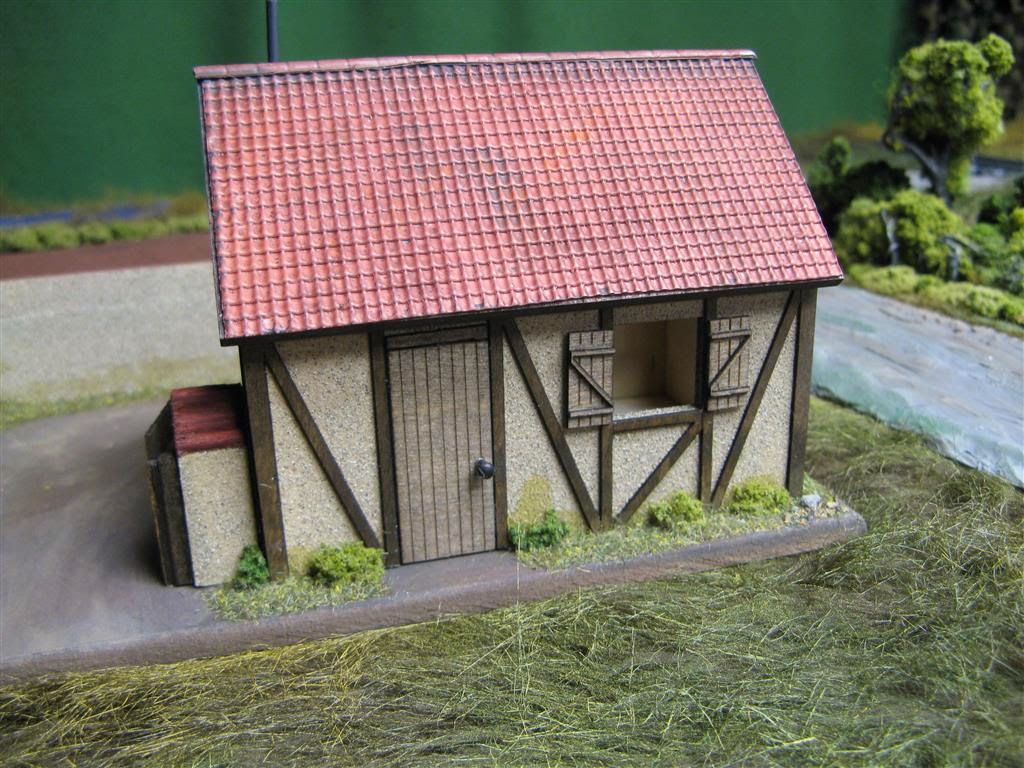
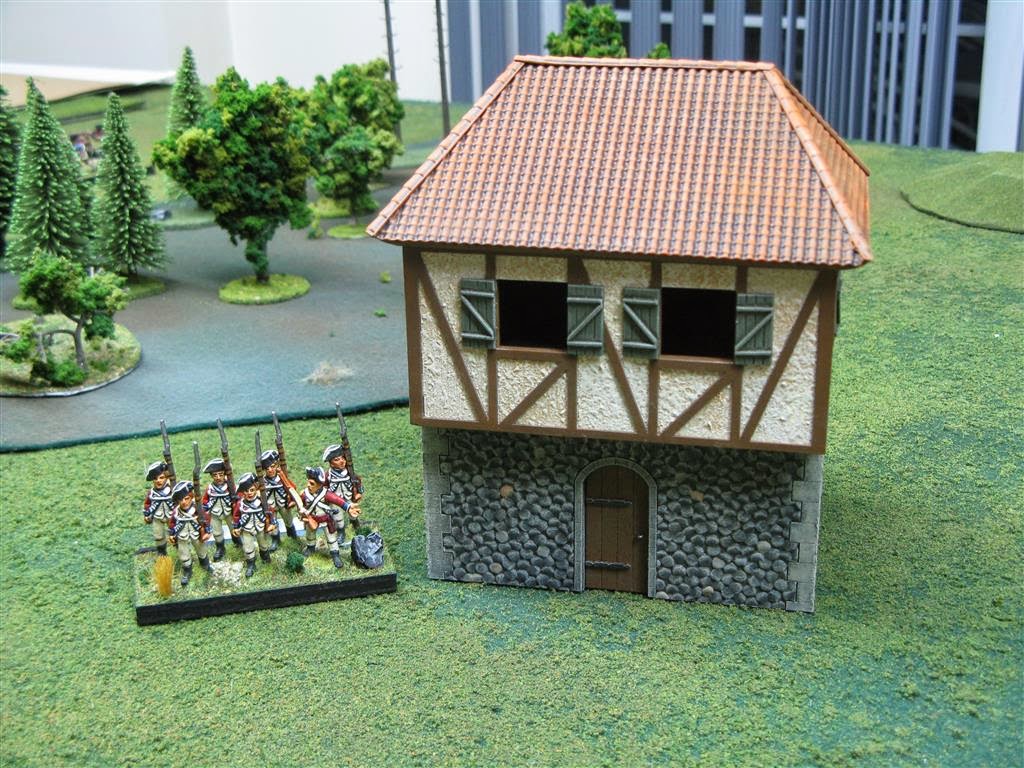
These are two more laser-cut buildings I've designed, cut on my laser and built and painted. The cottage is a larger version of the cottage I posted earlier. The barn can also double as a carriage house. I intentionally made it small-ish as I'm planning on putting both of these on one base as a farmstead with fencing, etc. similar to how my uncle based his. Both buildings have removable roofs for figure placement inside.
Look for future photos of these pieces based up as a single farmstead terrain piece.
I just returned from an enjoyable day at the Huzzah! 2014 convention. This is a fine local convention run by our wargaming neighbors to the north in the Portland, ME and surrounding areas. It's always a good convention to go to to game, shop and meet up with friends I see sometimes only 2-3 times a year at the local conventions.
This year the game quality and particularly the terrain seemed to be up a good bit from the norm. There were many very good looking tables and many excellent figures and vehicles. My booty from the vendors was more 28mm terrain both painted and un-painted as well as some unpainted 28mm British commandos and some Jeeps to transport them in.
My uncle has been wanting a small train station for his 28mm Bolt Action tables. He has some good track and a train, and what European town doesn't have a train station? This past Sunday we got together and designed one in the CAD system and cut the parts on the laser. These are the in-progress shots of the shell made from the parts straight off the laser with just glue added. Hopefully with some paint and roof texture this will make a fine addition to his table.
We aimed for a small village station. Buildings in 28mm tend to dominate the table even when on the small side. This village station has room for a ticket booth and some sitting area, and doors to the street, train platform and loading platform. The train platform has a cantilevered roof to shield passengers from the elements. The building will eventually be painted in a stucco finish and there are faux stone corner block details that will be glued on after the stucco finish is applied. Both my uncle and I are quite happy with the model so far. I'm excited enough about it I plan to make one for myself and obtain some track and a train.
Last Friday we played another Bolt Action WWII game at my Uncle's house. He's been fine tuning an American assault on a German held down in preparation for running such a scenario at our club's game night. This most recent edition is the result and provided us with the most balanced game so far. The Germans had early success knocking out the only American Sherman tank with a Pak-40 AT gun. They continued this streak destroying one of my infantry platoons with a great burst of fire from a full Grenadier squad . The Americans licked their wounds and pressed on eventually overwhelming the Germans on the flank opposite mine while I did my best to create a diversionary attack on our weak flank. The Germans will receive an additional panzershreck team for the game night version, but besides that I believe the game is set.
This is the 28mm stone and half-timber house/inn that I posted last week with a new water wheel added to it. I've designed the wheel so that it appears to be one piece with the building, but it's actually a separate piece allowing me additional versatility with the previously created building.
My uncle pointed out that we have a lot of tabletops with streams and rivers on them but you rarely see a mill. He also pointed out that mills typically have stone on the mill side to protect the building from the water and my stone building would make a good base for conversion to a mill.
The water wheel and stone tower supports for it are laser cut. The river and cut stone channel are hand made. The channel is designed to match existing river pieces I already had, shown in the photos. While most mills use a dam or waterfall to drop water on top of the wheel, I have found photos of several historic mills which used passing water current in the configuration I've chosen to use. This and the fact that it's quite impractical to have a large enough height shift in a regular wargame table to facilitate a waterfall or dam makes this the best choice.
Last night I was invited to play another Bolt Action WWII game at my Uncle Ralph's house. The scenario is one he's play testing for one of our club's upcoming monthly game nights. The scenario was a German defense of a town and three stone bridges across a small river. Attacking was a large force of American infantry with good armor support.
The American forces used several smoke screens to mixed success. They were able to neutralize a Flakverling quad 20mm AA gun, but the smoke destined to cover the Pak 40 AT gun drifted off target. Although the Pak didn't do any damage, the machine guns covering it had plenty of GIs to shoot. This was a fun and beautiful game. Ralph will me making some slight adjustments and we'll give it one more play test before club game night. Even with the adjustments the game needed it was still a ton of fun.
Ralph sent me the lead photo above, and the following tabletop photos, which show quite nicely how beautiful the terrain for this game was.
In addition to the game, Ralph also made a terrain piece of a small farmstead with a large walled yard and a pig stye. This terrain piece features a half-timber cottage Ralph made from my laser-cut parts. This is a slightly revised version of the cottage I posted earlier. Ralph's addition of the walls, and his expert decoration of the entire piece really puts the laser-cut cottage in the best possible surroundings - stunning! Ralph has also added a stovepipe on the roof instead of a chimney. For such a small domicile this makes a lot of sense to me, and looks wonderful, right down to the roof staining from the pipe.
I have one of these re-designed cottages completed as well that hasn't yet been posted to the blog. Before I photographed it I lent it to Ralph to use as an example on how to build his. I'm very much considering imitating Ralph's terrain piece. The creativity in it adds a lot to the original building.
This is another 28mm building I created with help from my CNC laser engraver. It's a 28mm stone and half timber house or inn. The stone lower floor is wrapped in cardboard on the edges cut to look like cut stone with the center field made from an interesting textured paper (shown below) I found at the local craft store. Once sprayed with black primer and dry brushed it looks convincingly like stone. There's also a detail photo of the door with its hardware, also cut on the laser. The roof is the only part not cut and engraved on the laser. It's made from sheet styrene made for scratch building HO scale buildings for model railroad layouts.
This building, like my others, is designed to easily allow troops to be placed in each floor. Each floor may be opened/removed separately to allow access for figures. I carved a chimney out of pink insulation foam which will be added to the roof, but it requires several coats of foam sealer and paint, all of which will take a few days to dry between coats.
Tonight my friend Charlie and my uncle Ralph stopped by to help me with some testing, and design suggestions for my secret project, which I'll now reveal, although I'm a long ways off from it being ready for public consumption. Since a large portion of my wargaming energy will be focused on this project I'm going to spill the beans now so I can blog about it.
The project is a new computer-moderated set of wargaming rules that I'm writing and programming. The system will use mobile devices (tablets, phones, etc.) for data entry. Each player can either enter their own information or have an opponent do so for them. In use the device screens serve many of the same purposes as the quick reference sheets most rules use, and after a test session Charlie and Ralph think using the mobile device as a 'smart' QRS and doing your own data entry while playing may be preferable to having an opponent do the data entry for you.
Using multiple tablets streamlines the data entry process. This eliminates the need for players to wait for the GM to enter data for them, while still providing the fog of war and detailed record keeping that the computer allows. While we only used 2 tablets for our test session, the system will be able to scale up to huge games with dozens of tablets if desired. This is a mobile-friendly web application and not a device specific 'app'. This allows it to function equally well on Apple, Android and Microsoft portable devices. Entering each unit's information is done completely with button clicks in the interface. No typing skills are needed and everything is simply presented to further streamline use. I wanted this system to enhance the gaming experience, not get in the way.
As expected, the play test revealed many places that need a large amount of improvement. My test scenario was a reduced order of battle of the battle of Freeman's Farm. While we were happy with the flow of the user interface, I still have some significant adjustments to do in the morale calculations. I also still have to add passage of lines and fatigue to the system. During play several other smaller suggestions were made which, once implemented, I feel will be great improvements.
The system will handle battles from the black powder era: post 30-years war up to about the Franco-Prussian war. My play test progression will be AWI, then ACW and finally Napoleonics. Each period adds additional complexities which will fully test the development of the system. For the foreseeable future this is a personal project. Possibly a year or more from now I may feel it ready for public consumption. Until then please feel free to comment and live vicariously through the blog posts....oh and wish me luck!
Video of a couple of units being entered into the system:
Last Saturday a few of us got together to play test my friend Robert's home brewed Napoleonics rules, lightheartedly named "Robert's Rules of Disorder". The rules are based on a model that involves die rolls, but ensures somewhat predictable, although variable, casualty rates. It's an interesting concept and so far the rules seem like they're going to be a lot of fun.
This session involved doing some 'what if' attack and defend scenarios of corps vs. corps sized forces. We were able to come up with some constructive suggestions for Robert while having a lot of fun. Win-win for everyone.





 Posts
Posts


 In addition to the game, Ralph also made a terrain piece of a small farmstead with a large walled yard and a pig stye. This terrain piece features a half-timber cottage Ralph made from my laser-cut parts. This is a slightly revised version of the cottage I posted earlier. Ralph's addition of the walls, and his expert decoration of the entire piece really puts the laser-cut cottage in the best possible surroundings - stunning! Ralph has also added a stovepipe on the roof instead of a chimney. For such a small domicile this makes a lot of sense to me, and looks wonderful, right down to the roof staining from the pipe.